The Unexpected Angles in Raabta’s Wedding Album
From a ceremony seen between raised hands to a couple held within a mountain landscape, Raabta by Shrey Bhagat changes the viewer’s position to reveal another part of the wedding story.

4 minute read
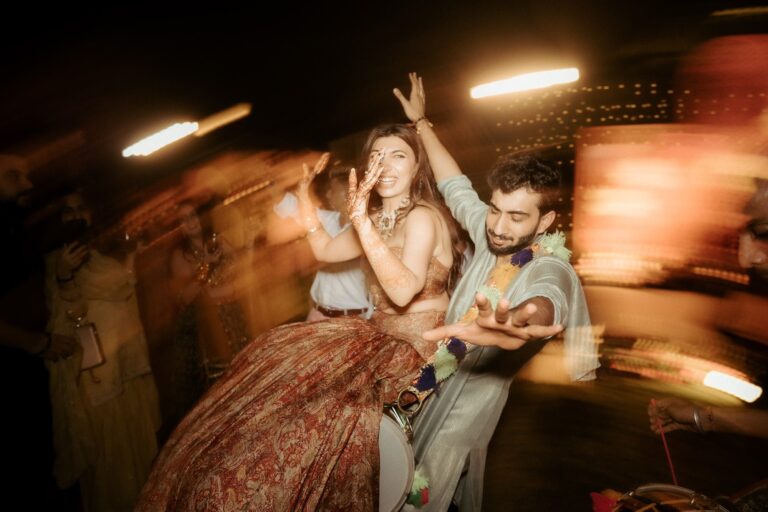
An upward view frames two faces between raised hands, bangles and red flowers.
Look Up Into the Ceremony
The camera appears to be below almost everything. Hands and bangles rise at either side of a Raabta photograph, red flowers cross the foreground and two faces lean into the space above. The view is unusual, yet the exchange remains readable. The photograph puts the viewer within the arrangement of people and objects, rather than at a polite distance from it.
The angle changes the relationship between the ceremony and the camera. Flowers become a frame close to the lens, while the faces occupy the opening beyond them. The ceiling supplies a grid above the figures. Several distances are compressed into one image, creating a sense of participation through the way the elements overlap.
A luxury wedding often supplies an abundance of beautiful details to photograph. An unexpected viewpoint can give those details a more active role. Here, the bangles and flowers help explain how the people are positioned in relation to one another. They belong to the exchange, carrying the ceremony into the structure of the picture.
Raabta by Shrey Bhagat was founded by Shrey Bhagat and Manveen Ahuja Bhagat. The studio describes observation of people and relationships as the beginning of its process. The interest in this photograph lies in how a changed viewpoint makes a familiar ceremonial encounter feel newly visible, while keeping the human connection at the centre of the frame.
Step Back Far Enough to See the Setting

A photograph beside water takes the viewer much further away. Two figures stand among rocks, with mountains rising behind them. The landscape occupies a substantial part of the frame. The couple has a clear place within it, but the image gives the setting enough room to establish its own proportions, surfaces and changes of light.
This distance offers a different kind of information. A close view can preserve an expression, while a wider photograph explains how people appear within a particular place. The rocks establish a foreground, the water extends the scene and the mountains give it a larger outline. The figures connect those distances to a human scale.
For a wedding portrait, that relationship can be more interesting than placing a couple in front of a recognisable landmark. The surrounding place enters the composition through its actual shapes and depth. The viewer can understand where the figures are standing and how the space continues around them, even without being told the identity of the location.
There is also a change in the kind of attention the image invites. The upward ceremony photograph is full of nearby objects. The landscape view opens around the people, allowing more space between the elements. An album can use that change of distance to move from the closeness of a gathering to a portrait that has a more expansive visual rhythm.
The studio’s emphasis on the particular character of each celebration supports this variety of viewpoints. A setting can matter without becoming the whole subject. Its role is resolved through its relationship with the people, whether the photograph is made from within a ceremony or from far enough away to include the landscape around a pair of figures.
Come Back to the Exchanged Glance
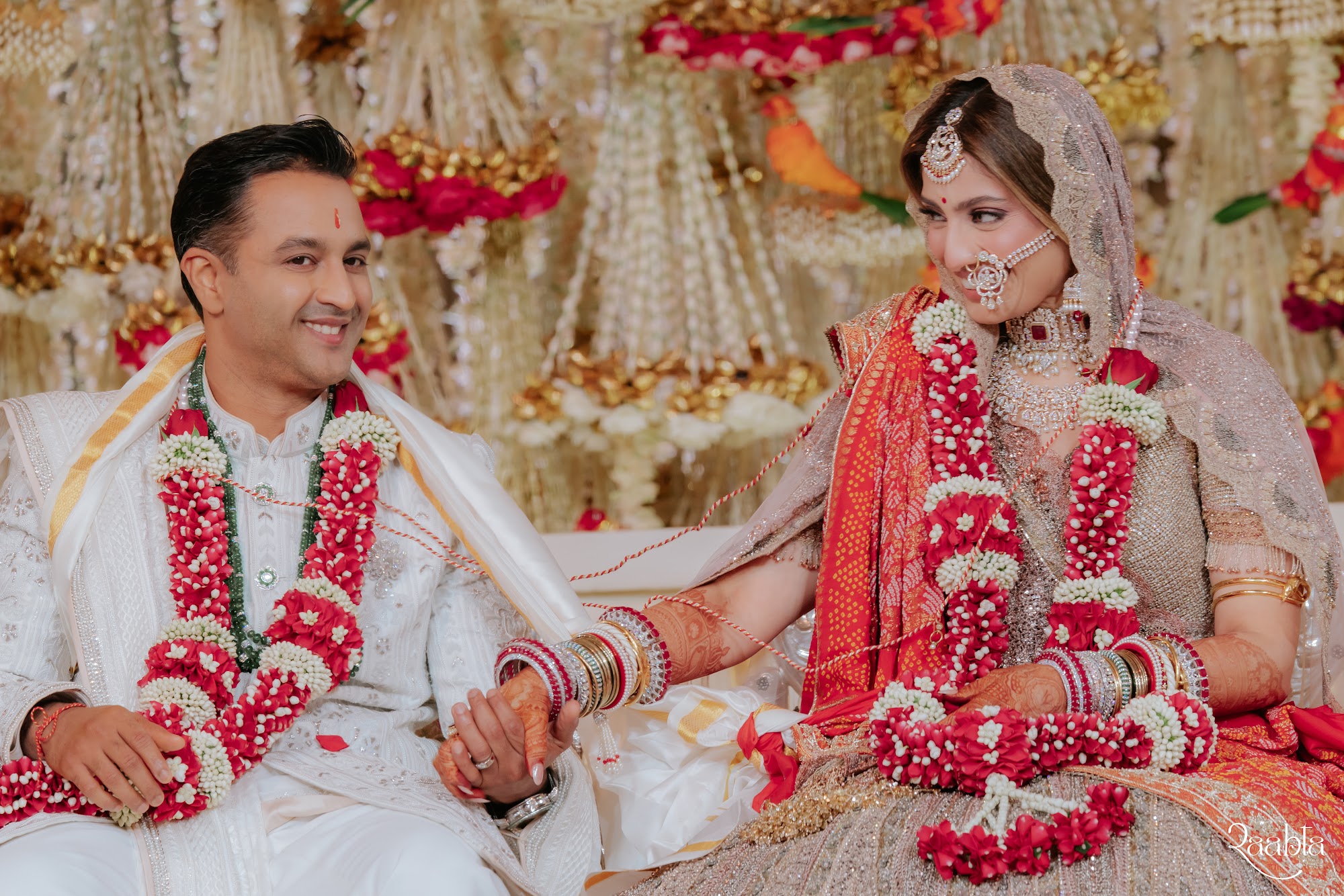
A seated couple brings the camera close again. Their faces turn towards one another, with red garlands and the details of the ceremony visible around them. The view is more direct than the first photograph, but it has a similar centre of interest. The relationship between the two expressions gives the surrounding ornament its human context.
An exchanged glance can organise a photograph with very little explanation. The viewer follows the direction of one face towards the other, reading the space between them as part of the image. The ceremonial details establish what kind of occasion is unfolding, while the people supply something specific within that larger visual language.
The most useful change of angle is therefore a change that reveals something. A lower viewpoint can make the viewer aware of hands and flowers; a wider one can describe a landscape; a closer one can bring two expressions into relation. Novelty has a purpose when it adds another piece of information to the wedding story.
There is no single distance from which a wedding can be completely understood. The larger edit needs room for the setting, the ceremony and the encounters that make the gathering personal. Changing the camera’s position can bring those different kinds of information into the album, giving each view a reason to exist alongside the others.
Raabta’s most engaging angles invite the reader to occupy those different positions. The camera can look up through the action, stand back from a landscape and return to the expression beside another face. A familiar wedding moment gains another dimension when the photograph makes it possible to see a relationship that might otherwise remain outside the frame.
Photography supplied by Raabta by Shrey Bhagat.