
Your Wedding Tasting Should Rehearse the Dinner You Are Actually Hosting
A perfect bite in a quiet tasting room is only the beginning. Test the portion, the service journey and the dishes your guests will eat together.
A wedding tasting can become a procession of favourites: one beautiful canapé after another, followed by a table of dishes that nobody has to queue for. It is a pleasant afternoon. It can also leave the most consequential questions about dinner unanswered.
The better brief begins with the event: who will eat, where they will eat and how the food will reach them. Sage & Saffron describes event catering that encompasses ingredients, service and tablescapes. That breadth is a useful starting point for any tasting appointment. Food and the way it is served belong in the same discussion. (Sage & Saffron — Event Catering)
Send the evening before you send the wish list
Give the caterer the running order, expected attendance at each meal, venue access and proposed service format. Explain whether guests will be standing through cocktails, sitting through performances or arriving in several waves.
Share dietary requirements as a separate, clearly labelled brief. Ask how the team will identify dishes, communicate ingredients and handle individual requests. A vegetarian selection and a guest’s specific allergy requirement need distinct conversations with the caterer.
Take the people who can make decisions. A tasting attended by every relative can generate a long list of additions with no agreed menu at the end.
Taste in the order guests will eat
Ask to move through a plausible sequence, including accompaniments and the proposed portion. A rich starter may be delightful alone and tiring before another rich course. Two excellent dishes may use a similar sauce, texture or flavour profile.
Keep a short scorecard: taste, portion, ease of eating and place in the menu. Record what should change. “Less sweet, retain the acidity” gives the chef something usable; “make it more wedding-like” does not.
For standing service, try the canapé with the actual plate or serving vessel. Can someone manage it while holding a glass? Does it require a knife that will not be available? Judge it as a guest would receive it.
Ask for a service demonstration
Identify dishes that depend on immediate finishing. Ask the team to explain the journey from preparation to pass to table, and whether a sample can follow the intended service process. The caterer should determine appropriate food handling; a family tasting should not improvise holding conditions.
For a live counter, discuss how orders will be taken and how finished portions will be collected. Ask what happens when several tables approach together. An impressive cooking demonstration does not by itself show how a busy station will operate.
Leave with a menu someone can execute
Request one written revision covering agreed dishes, portion format, dietary alternatives, serving vessels and the changes made during the tasting. Identify any item still awaiting a second sample.
Finish by asking who approves substitutions and how late changes will be communicated. The tasting has done its job when it produces a clear service plan and a meal with a coherent beginning, middle and end.
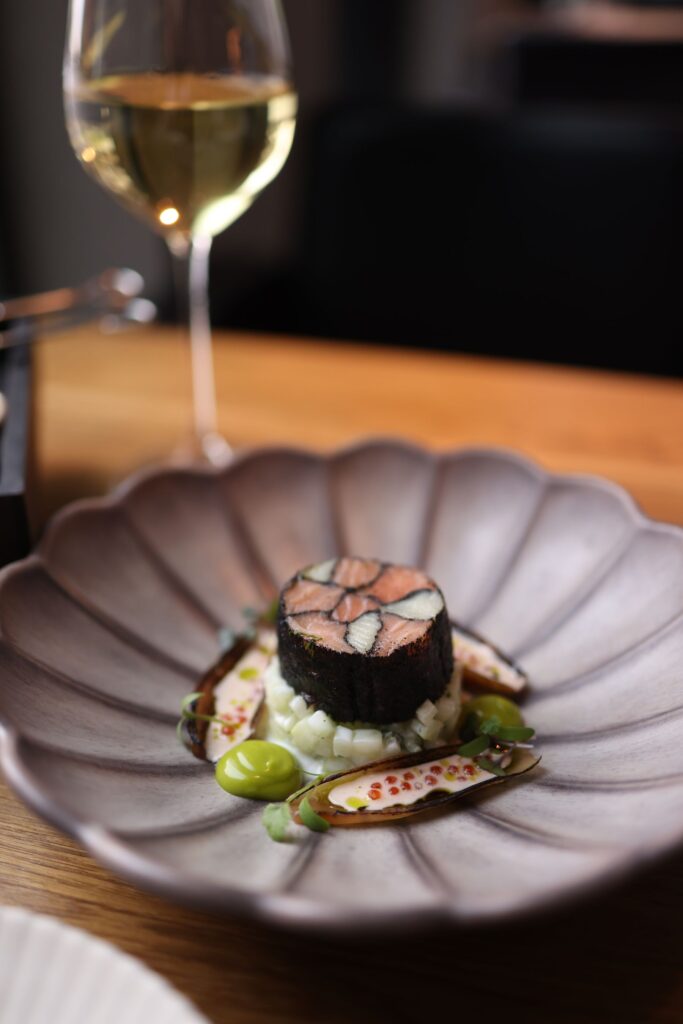
A plated restaurant dish as a reference for presentation and portion assessment; not a Sage & Saffron dish. Photography: Valeria Boltneva. Pexels License. Via Pexels.
Share this story
More stories like this

Ten Menu Mistakes Guests Notice Before the Hosts Do
There’s More to a Drinq Wedding Bar Than the First Pour
