
The Heirloom Necklace Comes First. The Wedding Wardrobe Follows.
Before ordering another bridal outfit, bring the family necklace to the fitting. Its length, colour and fastening can make the most useful decisions for you.
A family necklace arrives with a history, but rarely with a complete styling plan. It may have a broad centre, a short fastening or a pendant that lands exactly where a blouse has its heaviest embroidery. Choosing the outfit first can leave the most personal object in the wardrobe competing for space.
For a bride building several looks, reverse that appointment. Start with the jewel you know you want to wear, then decide what should surround it.
Read the entire necklace
Lay it flat and look beyond the central stones. Notice the length, the drops, the back fastening and the colours in its setting. Ask a trusted jeweller to assess its condition and explain how it should be supported before a fitting. An inherited piece should not be altered simply to accommodate a blouse ordered too early.
Sabyasachi’s Heritage Jewellery collection offers a useful contemporary reference: its Maharani necklace interpretation gives the fastening a broad printed-velvet sash. The detail is a reminder that the back of a necklace belongs in the styling conversation too. It is a design reference, rather than a suggestion to modify a family jewel. (Sabyasachi Heritage Jewellery)
Fit the neckline around its resting place
Take the actual necklace to the atelier, or arrange a supervised fitting if it cannot travel. Photographs help communicate colour; they cannot show how the piece moves against your body.
Try the blouse seated and standing. Does the pendant fall onto embroidery, into the neckline or onto bare skin? Do raised embellishments catch the setting? Can the blouse fastening and necklace fastening coexist comfortably? A paper sketch of a deeper neckline will not answer those questions.
The neckline does not have to disappear. A clean curve, a deliberate border or a well-judged stretch of fabric can give the necklace an intelligible frame. Photograph each option at a normal portrait distance before choosing.
Let colour connect the wardrobe
There is no obligation to reproduce the colour of a gemstone across every garment. Try it in a narrow edging, a woven motif or a single accessory. Compare those subtle connections with a stronger colour pairing; the complete look will tell you which feels convincing.
Across a wedding weekend, the same jewel can read differently with a sari, a structured blouse or a relatively spare reception outfit. Repeating it can become a personal thread through the photographs, provided each look has been tried in full.
Stop adding when the composition is complete
At the final trial, add earrings, the head ornament and any ceremony layers one at a time. Check the front, side and back, including the point where a dupatta meets the fastening.
Give one person responsibility for collecting, handing over and returning the piece. Record that arrangement privately. The wardrobe is ready when the necklace sits well, the bride can move naturally and the family knows exactly where their treasured object will be.
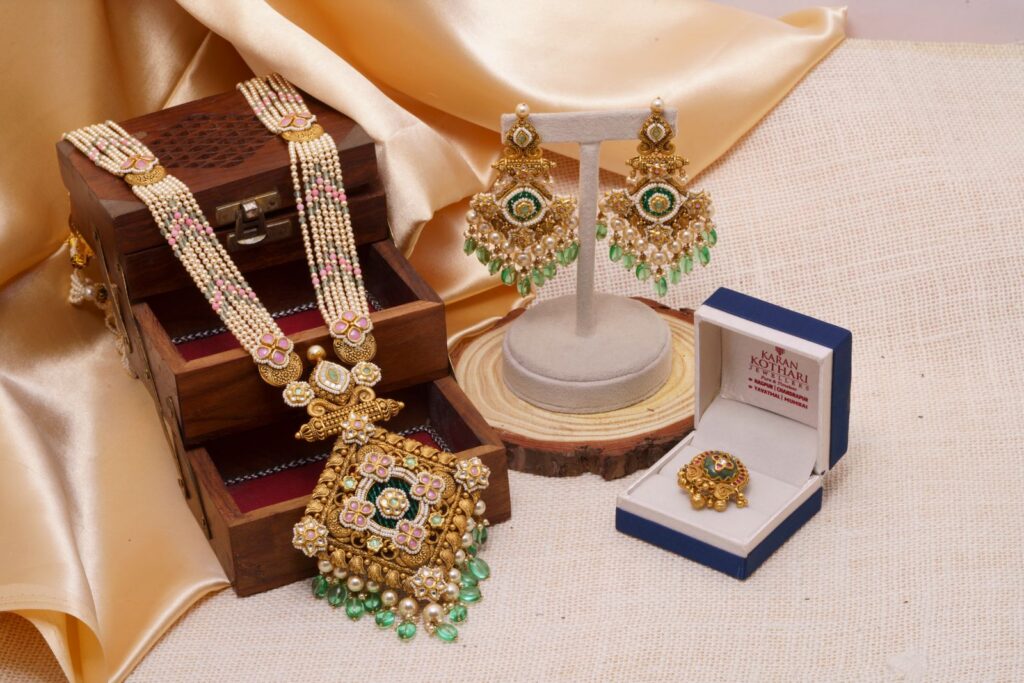
A necklace, earrings and ring arranged on silk and display boxes. Styling reference for building a wardrobe around a jewel; not identified as Sabyasachi jewellery or a family heirloom. Photography: Kunal Lakhotia. Pexels License. Via Pexels.
Share this story
More stories like this
The Bridal Cape: Drama Without a Second Dupatta?
Ten Ways to Imagine the Modern Indian Bride
