Ten Ways to Imagine the Modern Indian Bride
From mirror-work red to sculpted silhouettes and soft ivory, The Great Indian Wedding Book’s sixth edition brings ten design houses into a bridal conversation about craft, confidence and personal choice.
4 minute read
A wedding wardrobe begins with a feeling. For one bride, it might be the pull of a richly embroidered red lehenga. For another, an ivory ensemble with a sheer cape, or a fishtail silhouette beneath a long veil. The starting points differ, but the question is the same: what feels like you?
That question runs through The Great Indian Bride, the opening section of The Great Indian Wedding Book’s sixth edition. Bringing together Manish Malhotra, Falguni Shane Peacock, Abhinav Mishra, JJ Valaya, Amit Aggarwal, Ritika Mirchandani, Shantnu Nikhil Couture, Aisha Rao, Anita Dongre and Irth, the editorial offers ten perspectives on dressing for a wedding.
Photographed by Pravin Talan at Fairmont Mumbai, with styling by Tanya Ghavri and Hair and Makeup by Shradha Luthra, the story considers the complete picture: the outfit, the woman wearing it and the space around her.
“Bridal fashion is where many brides begin imagining their wedding,” says Atul Pandey, Publisher of The Great Indian Wedding Book and co-founder of India’s Best Wedding Makers. Bringing these design perspectives together, he explains, gives a bride room to consider different possibilities and discover what connects with her.
The Many Expressions of Bridal Red
Even within a familiar colour, the choices are expansive. Abhinav Mishra’s CRIMSON, inspired by the Rangoon flower, brings signature mirror work together with handcrafted embroidery and floral detailing. The result approaches classic bridal red through the texture and light of its surface.
Shantnu Nikhil Couture explores crimson through a lehenga from Becoming, where a sculpted bodice, sweeping proportions and tonal embroidery give the colour a different presence. Seen alongside one another, these approaches invite a bride to think about how she wants her outfit to move and feel, as well as how it looks.
At Manish Malhotra, EVARA pairs zardozi and zari embroidery with sculpted silhouettes. The designer’s advice extends beyond the wedding itself: “Let your heritage inspire you, let craftsmanship tell your story, and choose pieces that make you feel beautiful beyond the wedding day.” It is an invitation to imagine a trousseau with a life after the celebration.
Craft, Shape and a Personal Point of View
Elsewhere in the editorial, tradition takes different forms. JJ Valaya’s Siddi brings Indian and African influences into its design language. “I wanted the collection to feel rooted without being nostalgic,” says the designer.
Ritika Mirchandani’s The Third Path explores the meeting of traditional craft and contemporary form. Her advice puts the wearer first: “Choose pieces that celebrate your individuality while keeping comfort first.”
Aisha Rao’s Beatrice, from the Priyasi collection, pairs a beige appliqué fishtail lehenga with a long veil. Falguni Shane Peacock’s ivory ensemble combines delicate embroidery with a sheer cape, creating another interpretation of softness within bridal dressing.
For Anita Dongre, emotion provides a starting point. Her Forest Rose silk lehenga features threadwork, zari and sequins, with motifs inspired by a wild rose. “So, dress for the feeling you want to remember,” she advises. Together with the contributions of Amit Aggarwal and Irth, these looks broaden the editorial’s conversation about the possibilities of a bridal wardrobe.
Couture in Conversation With Architecture
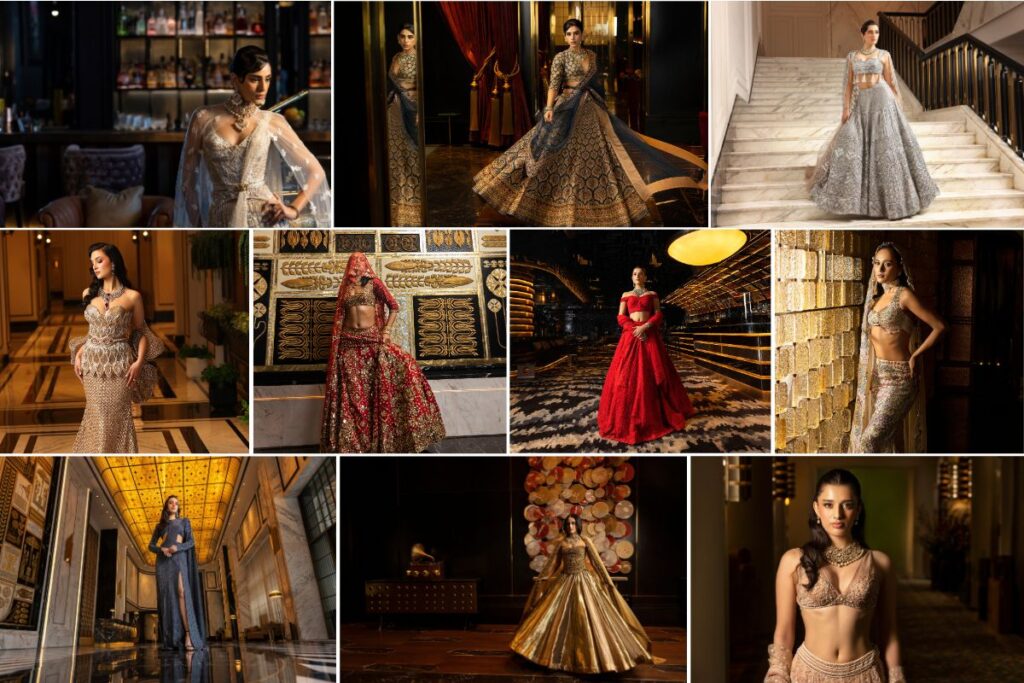
Fairmont Mumbai’s interiors give the photographs their scale and atmosphere. Talan uses the relationship between the clothes, the woman and her surroundings to build each image, bringing bridal couture into an urban setting.
His approach centres on mood, light and moments of character. In the accompanying collage, staircases, reflective surfaces and warmly lit interiors become part of the composition, giving the silhouettes distinct settings within one visual story.
Ghavri’s styling connects the different design approaches through jewellery, draping and the balance between clothes and accessories. Each look carries its own identity while belonging to the same editorial world.
Luthra’s Hair and Makeup follows that sense of balance, complementing each ensemble without overwhelming it. Her emphasis on knowing how much to do, and where to stop, reinforces the importance of seeing the look as a whole.
A Wardrobe With Room for You
For a bride planning across several ceremonies, the editorial offers a way to compare colour, silhouette and detail. Red can sit alongside ivory; embroidery can share a wardrobe with sculptural forms. The interest lies in finding a connection between those choices and the person who will wear them.
The Great Indian Wedding Book’s sixth edition opens with this exploration of bridal fashion before moving into the wider world of wedding planning, including venues, food and beverages, photography, invitations, gifting and entertainment. Its opening fashion story offers a fitting place to begin: with the freedom to imagine more than one version of a bridal look.
Photography: Pravin Talan
Styling: Tanya Ghavri
Hair and Makeup: Shradha Luthra
Location: Fairmont Mumbai
Images: Bridal editorial collage supplied by The Great Indian Wedding Book.
Share this story
More stories like this

Why the JADE Bride Deserves a Closer Look

The Case for Choosing Your Anmol Jewels Before Your Lehenga