
The Grand Wedding, Seen Up Close by Joseph Radhik
The architecture can be monumental and the flowers extravagant. In Stories by Joseph Radhik’s photographs, a hand beside a face or the space between two people can still become the detail that holds the frame.

5 minute read
Hands, flowers and a smiling bride create a close composition around a ceremony.
Begin With the Gesture
Several hands enter a close photograph of a bride. One rests beside her face; others appear around her head, with flowers and jewellery filling the spaces between them. She is smiling. In this image from Stories by Joseph Radhik, the ceremony is understood through the people within arm’s reach. A small area of the celebration holds a surprising amount of information.
The hands give the image its structure. They connect the bride to people who are partly outside the frame, allowing their involvement to remain visible without requiring a full group portrait. The expression at the centre holds those separate gestures together. The photograph records a relationship between a person and the gathering immediately around her.
Stories, founded by Joseph Radhik and Joshua Karthik, describes its interest in the personal details of a celebration, including glances, laughter and the intervals between principal events. This photograph gives that approach a concrete form. The occasion is richly dressed, yet the eye keeps returning to a face and the hands beside it.
That shift in attention is valuable in a luxury wedding album. The larger production can be recorded elsewhere. A close photograph preserves details that may be difficult to reconstruct later: who stood within reach, where a hand rested and how an expression appeared in that instant. The frame becomes personal through what it notices, without needing an elaborate account of what everyone was feeling.
Keep the Scale in the Frame
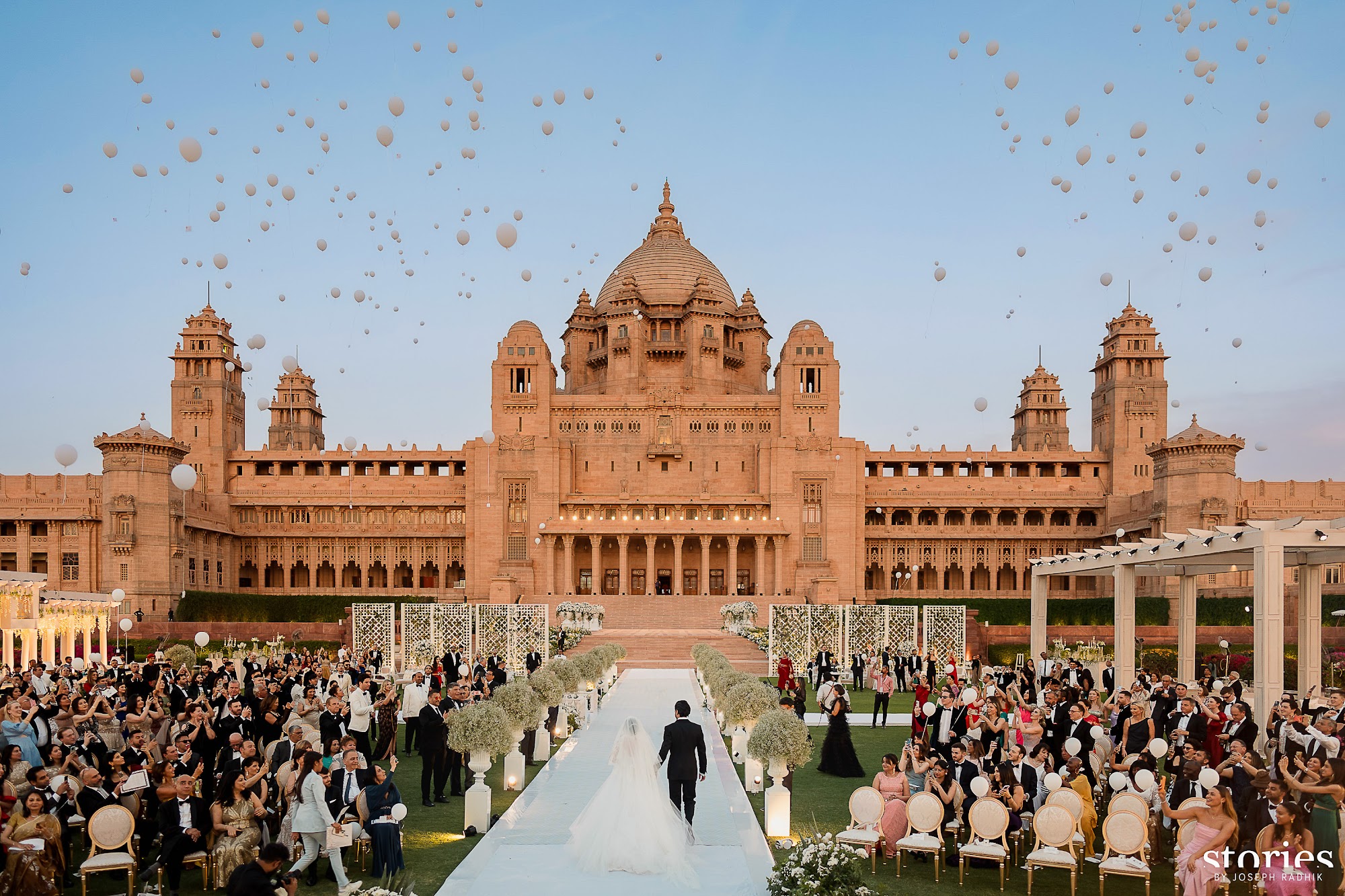
A much wider image places a wedding gathering before a monumental building. A long central route draws the eye towards the architecture, with people arranged on either side. The symmetry makes the scale immediately apparent. Here, the photograph gives the viewer enough distance to understand the relationship between the celebration and its setting.
That distance serves a different purpose from the close ceremony image. The wedding’s spatial ambition becomes readable: the length of an approach, the size of the gathering and the way the architecture frames the principal view. These are part of the occasion’s story too. They describe the environment in which the smaller encounters took place.
The people remain essential to the composition. Their presence gives the building a human scale and turns the central route into part of an event. Without them, the photograph would offer a different kind of information. With them, the image connects the grandeur of the setting to the gathering for which it has become meaningful.
A wedding edit gains depth when it preserves both distances. A close photograph asks the viewer to notice a gesture; a wide view explains where the gesture belongs within the larger occasion. Neither needs to carry the entire account alone. Their relationship allows the album to move between an individual experience and the celebration shared by many people.
Stories’ stated emphasis on people gives that movement a useful centre. The architectural photograph can be appreciated for its visual order, while the surrounding selection keeps returning to relationships. The scale has a place in the album because it supplies context for the people, rather than requiring every photograph to reproduce the same grand view.
Get Close Enough to See the Connection

Another image brings two figures close together, their faces and clothes covered in colour. The frame leaves very little room for the wider setting. The interest lies in their proximity, the direction of their faces and the expression visible between them. Colour is abundant, but it is the relationship within that colour that gives the photograph its focus.
The image does not need a complete view of the event to be understandable. The traces of celebration are carried on the people themselves. A coloured face or a hand close to another person can preserve the physical character of an occasion, allowing the viewer to encounter something of its closeness through a small, concentrated frame.
There is an important distinction between reading what a photograph shows and assigning a private meaning to it. A viewer can notice affection, animation or proximity without knowing the exchange that preceded the image. The couple and their families bring that knowledge to the album. A photograph can give them enough detail to return to their own account of the moment.
The different distances suggest a way to think about the complete wedding story. The wide view preserves the scale. The ceremony image holds the people gathered around one person. The close encounter makes room for a relationship that would be almost invisible from the back of the gathering. Each frame adds something the other views leave outside their edges.
The most lasting interest lies in the movement between those views. A grand wedding can be understood through its architecture and its visual ambition, then rediscovered through a face or a gesture. In this Stories by Joseph Radhik selection, the smaller frame does not reduce the occasion. It gives the people within it a place of their own in the story.
Photography supplied by Stories by Joseph Radhik.


