
The Hair Jewel Takes Centre Stage
Pins, chains and sculptural ornaments are giving bridal hair a more expressive finish, with placement becoming as important as the piece itself.
5-minute read
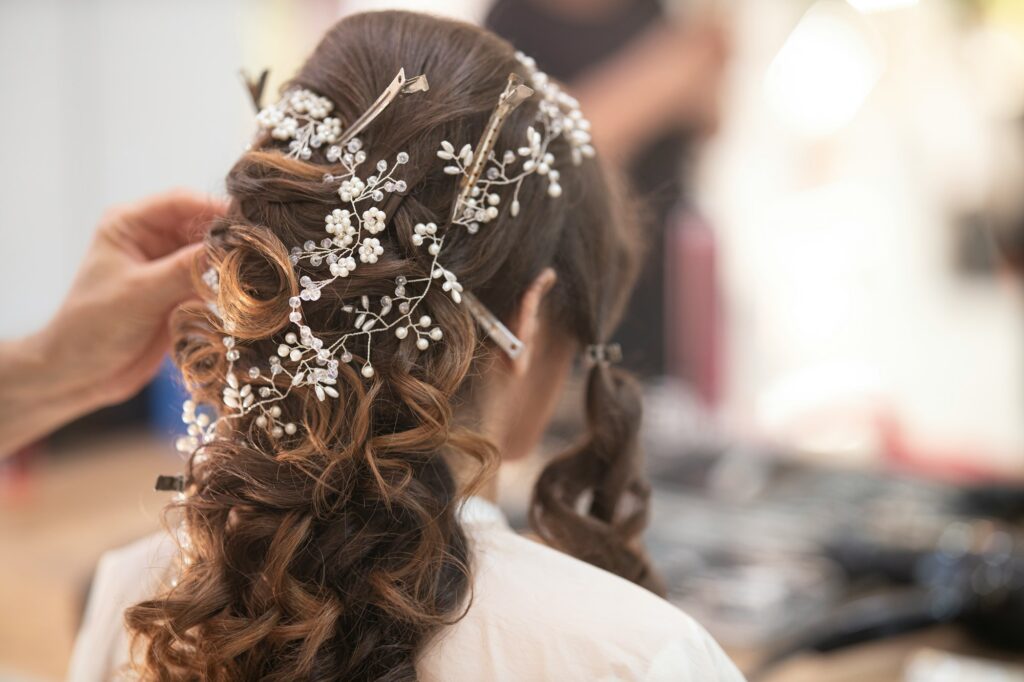
Illustrative photograph by engin akyurt / Unsplash.
A bride turns to greet someone, and the detail appears: a line of light through a braid, a small ornament tucked into the side of a bun, a jewelled shape following the curve of her head. Hair jewellery offers this pleasure of discovery. It can remain quiet in a front-facing portrait and reveal its character as the woman moves. At a wedding, where a look is encountered from every direction, the back and profile of a hairstyle deserve the same attention as the face.
Current bridal beauty coverage is giving these finishing pieces renewed attention, from jewelled headbands and adaptable pins to traditional ornaments worn through a braid. The appeal is broader than sparkle. A hair jewel can alter the scale of a hairstyle, connect it to the clothes or give an otherwise simple look a more ceremonial presence. Its success depends on the relationship between the object, the hair and the woman wearing both, rather than on the ornament's size or prominence alone.
Start with the shape of the hair
The hairstyle should help determine the piece. A compact bun offers a different surface from a long braid; loose waves create another rhythm around the face. A pin can provide a single point of emphasis, while several small elements may establish a line. The aim is to understand what the hair is already doing before introducing jewellery. An ornament becomes more convincing when it participates in the shape rather than appearing to have been placed on top of a finished look as an afterthought.
Proportion is easiest to judge on the wearer. A piece photographed close up may be much smaller than expected, and a delicate chain can become visually busy when combined with flowers and a veil. The hair trial offers a chance to see the actual objects together. Looking from the front, side and back helps reveal whether one view has become crowded or another feels unfinished. A bridal hairstyle exists in three dimensions, and its finishing detail should make sense across all of them.
The face remains part of the composition even when the jewel sits behind it. A low ornament can bring attention to the neck, while a higher placement changes the outline around the crown. Earrings and the neckline influence that balance too. Sometimes moving a piece a few centimetres is more effective than choosing a more expensive one. The final arrangement should allow the bride's features and expression to remain legible, with the jewellery contributing to how the whole look is read.
Give tradition a specific place
Indian bridal hair already carries rich ornamental traditions. A piece worn along a braid or near the parting can have a meaning beyond its appearance, and families may bring their own ways of wearing it. These references deserve to be understood rather than treated as interchangeable styling motifs. A conversation with the bride, her family and the relevant maker can establish what matters. The resulting look can feel contemporary while remaining attentive to the significance of the objects it includes.
There is no need to combine every possible reference in one hairstyle. A particular ornament may be allowed to hold the composition, with flowers or other jewellery taking a supporting role. A bride might reserve a fuller traditional arrangement for the ceremony and choose a more edited piece later. This gives each occasion a distinct feeling without diminishing either. The wedding wardrobe becomes more expressive when its beauty decisions have their own purpose, instead of repeating the same level of embellishment throughout the day.
A brooch or another family piece may offer an interesting possibility, but adaptation needs care. It should be assessed by the people responsible for its construction and placement, particularly if it is valuable or delicate. The idea is to find an appropriate use for the object without compromising it or the hairstyle. A sentimental detail feels most satisfying when it is secure and comfortable, allowing the bride to enjoy its presence rather than spend the ceremony wondering whether it will remain in place.
The trial is also a fitting
Hair jewellery needs a practical rehearsal. Weight, fastening and the relationship with a dupatta or veil should be tested together, with the actual piece wherever possible. A photograph of a similar ornament cannot reveal how the chosen one behaves. The bride should be able to turn, sit and move naturally during the trial. The stylist can then assess whether the arrangement needs another kind of support or a different placement before the pressure of the wedding day makes every adjustment feel more urgent.
Comfort has a visible effect on the finished look. A bride constantly aware of a pulling pin or an unstable ornament may hold her head differently or keep reaching toward the same spot. The solution is not to persuade her to tolerate it for the photographs. It is to reconsider the arrangement. Skilled bridal styling makes the decorative idea practical for the person wearing it, so that the final result can stay part of her appearance without becoming the subject of her attention.
The plan should include removal or transition as well as application. If a veil comes off before the reception, the hairstyle beneath it needs to look complete. If an ornament will be changed, the stylist and bride should know how that change will happen. A small, well-chosen piece can become the link between two looks. Thinking through this sequence prevents a beautiful ceremony arrangement from leaving the evening version feeling improvised or dependent on last-minute work in an unfamiliar room.
Choose the photographs you want to remember
A detailed back view can record the workmanship, but it should be one part of the visual story. The ornament also deserves to be seen while the bride greets someone, moves through the ceremony or leans toward a friend. These photographs show how the jewel belonged to the day. A brief conversation with the photographer can make them aware of its significance without turning every moment into an exercise in displaying it. The detail is most compelling when it appears within a relationship or a gesture.
Lighting will change its presence. A highly reflective piece can behave differently in direct sun, soft indoor light and flash photographs. The trial can include a few straightforward pictures in comparable conditions to establish how the arrangement reads. This is less about achieving a flawless image from every possible angle than understanding the effect of the choices already made. The bride and stylist can decide whether the look needs a quieter finish, a different position or simply more space around the ornament.
The hair jewel's lasting appeal is its ability to reward a second glance. It can bring the intimacy of a family object to a composed bridal look, or introduce a modern sculptural note to a familiar hairstyle. Yet the final image should still belong to the woman: her head turned in conversation, her expression unguarded, the ornament catching a little light behind her. The most beautiful finishing detail makes that moment more vivid without asking her to hold still for it.
Share this story
More stories like this
The Bridal Beauty Detail Shradha Luthra Wants to Preserve Is You
Isha Multani and the Art of a Personal Bridal Wardrobe
