Why the Walk to the Mandap Matters at a Knotie Production Wedding
Layered doorways, routes across water and a ceremony held in view. Knotie Production’s settings turn the approach into part of the wedding experience.

4 minute read
Successive decorated arches create a view through a richly coloured entrance.
An Entrance With Something Beyond It
The first arch opens onto another, and then another. In a Knotie Production photograph, red and warm orange surfaces carry pale decorative patterns through a sequence of doorways. Flowers gather at their bases. The view continues through the centre, making the entrance feel like the beginning of a route rather than a single place to stop.
That depth changes what an arrival can offer. Guests see a suggestion of the setting ahead before they reach it. The repeated frames create anticipation, while the continuing path gives them somewhere to go. The decoration establishes a mood through the experience of approaching, passing through and looking beyond.
The repetition also gives the ornate treatment a clear structure. Each opening belongs to the same family of shapes, so the eye can follow the sequence even as it takes in the surface detail. The palette holds the view together. The result has richness without losing its direction.
Knotie Production treats wedding design and production as parts of one narrative. This entrance offers a concrete way to understand that proposition. A drawing of several arches becomes a space that people move through. Its success depends on how the separate structures relate to one another, and on whether the intended view remains persuasive from the guest’s position.
Make the Approach Part of the View
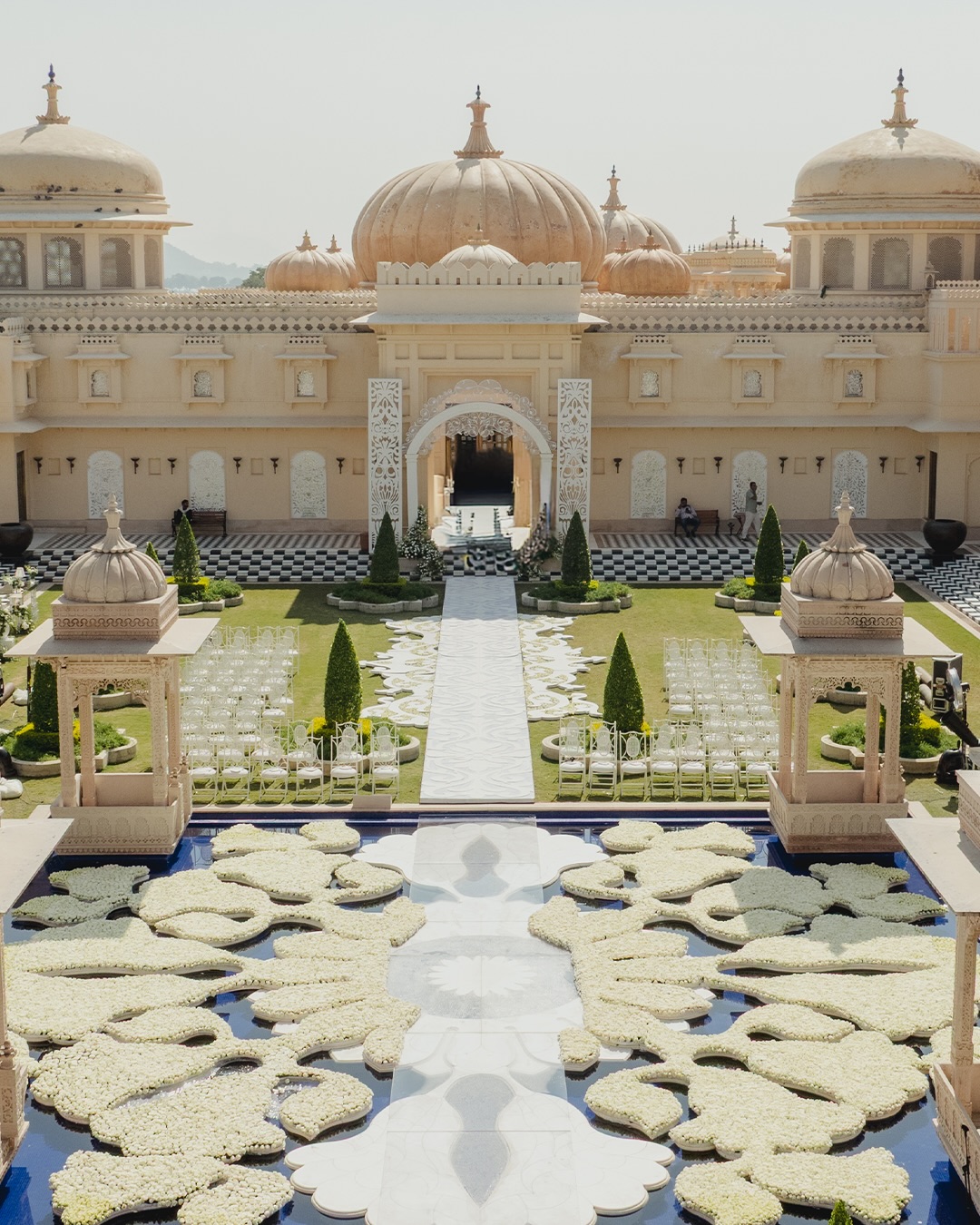
Another portfolio image exchanges saturated colour for pale architecture and a more open composition. A central route leads towards a domed setting, with circular forms arranged across the reflective foreground. The symmetry makes the destination immediately apparent. There is room to appreciate the approach as a whole before noticing the individual shapes around it.
This is a different kind of entrance. The first scheme builds interest through successive thresholds. Here, a longer view establishes the relationship between the route and the architecture beyond it. Both compositions give the act of arriving a visible form. They invite guests to understand the setting through movement, rather than only through a photograph taken after they have reached it.
For a wedding ceremony, the approach also carries an emotional function. It is the interval in which the people gathered turn their attention towards an arrival. Its scale affects how that moment is seen. A long route can make the gathering feel expansive, while a shorter one can bring the couple into close relation with the guests much sooner.
The design conversation therefore extends beyond decoration. The position of chairs, the direction of the ceremony and the places from which guests watch all influence the experience. A route that looks convincing from a distant camera position also has to make sense to the people beside it. Their view belongs within the composition.
Knotie’s combination of design and production gives those relationships a practical setting. The team remains directly involved through the stages of making and execution. In an arrangement built around repeated shapes or a clearly defined central line, the alignment of the parts contributes to the overall impression. The larger gesture is carried by many smaller decisions.
Give the Ceremony a Clear Destination
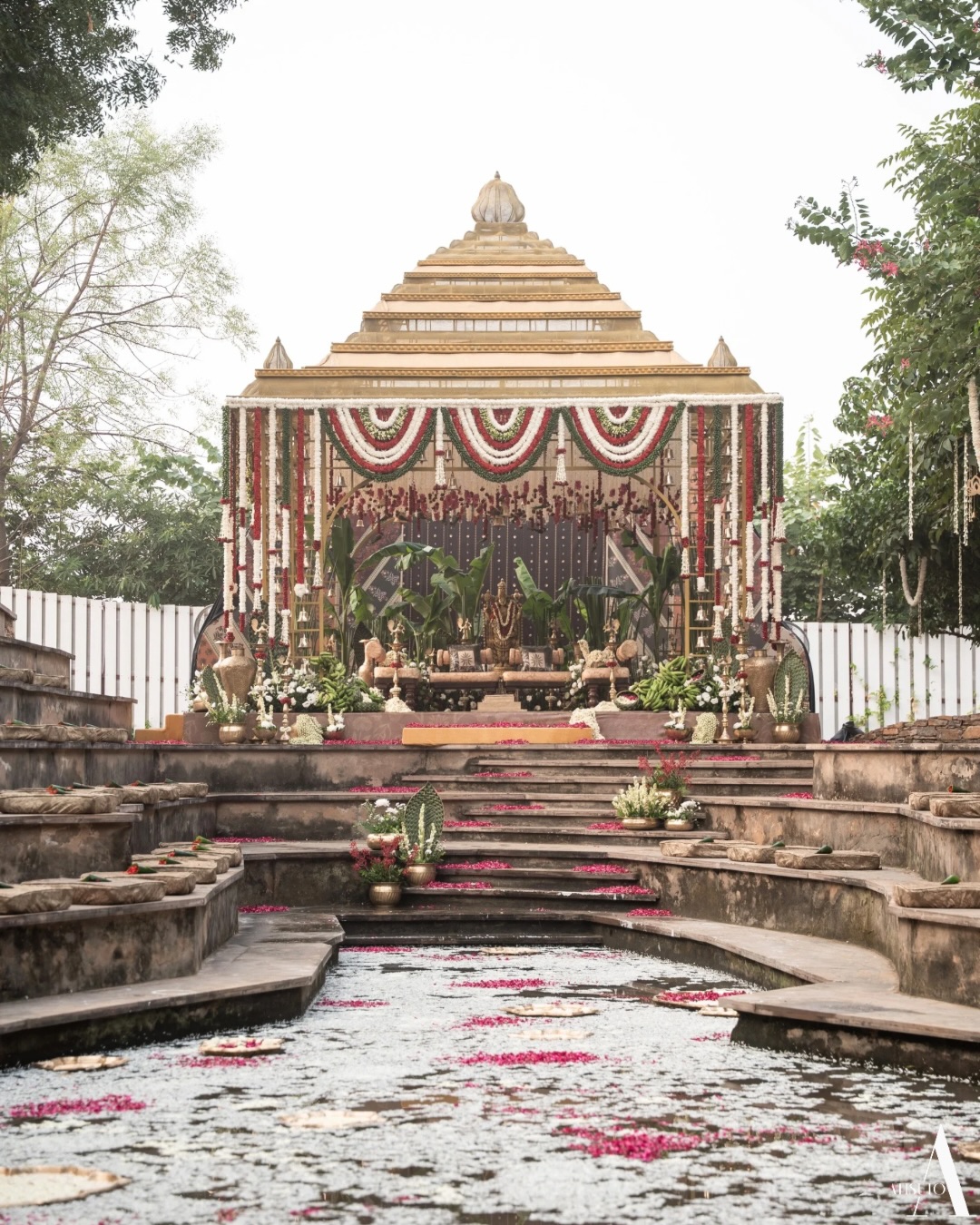
A pavilion beside water brings the journey to a more concentrated view. A tiered roof and hanging floral details establish the ceremonial structure, while greenery frames its sides. The foreground creates distance. The pavilion can be understood as the destination before its closer decorative details become apparent.
Its appeal comes from that relationship with the setting. Water, planting and the built structure each have a place in the view. The photograph does not need to fill every interval with another feature. The ceremony gains presence through the space around it as well as through the decoration attached to it.
Across these images, there is a useful distinction between grandeur and the accumulation of objects. A generous approach, a repeated frame or a setting held across water can establish scale through proportion. Flowers and patterns then give that structure its character. The effect depends on the way the parts are arranged, allowing a richly detailed wedding to retain a clear centre.
The same care matters once people occupy the space. An entrance has to accommodate a gathering, and a ceremonial route has to remain understandable as attention shifts towards the couple. The passage from arrival to ritual is part of the wedding itself. Design can give that passage a rhythm, providing moments of anticipation and moments in which everyone knows where to look.
Knotie Production’s most revealing proposition in this selection lies in that connection between the constructed setting and the occasion unfolding within it. The walk gives guests time to encounter the wedding’s visual world. The ceremony gives that world its purpose. When the two belong together, the entrance becomes part of what the celebration feels like to attend.
Portfolio images supplied by Knotie Production.