The Wedding Ceiling Gets Its Close Up With Seven Steps
Suspended flowers, illuminated forms and an architectural backdrop. Seven Steps Weddings shows how the space above a celebration can change the experience below it.
5 minute read
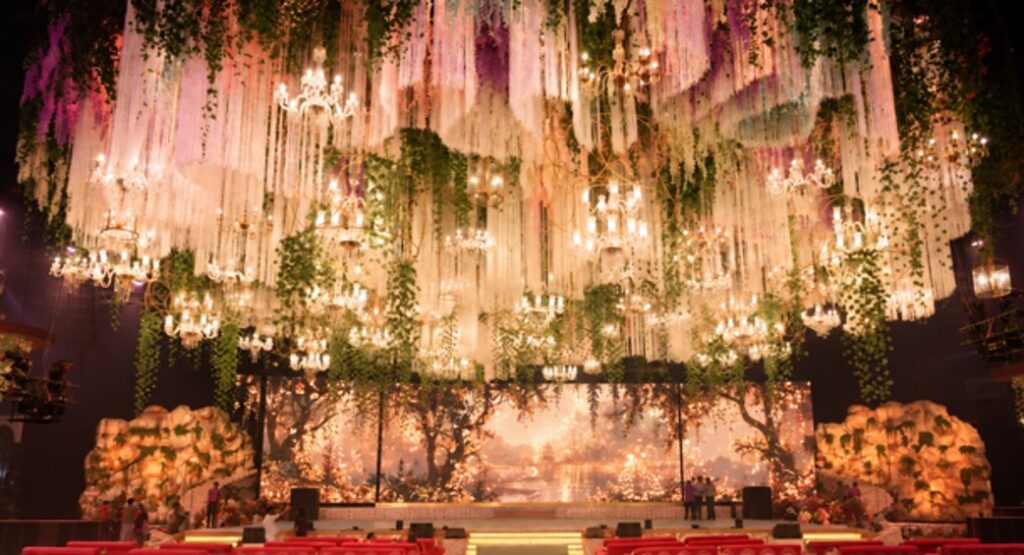
Flowers and hanging lights create a layered canopy above an evening setting.
Give the Room a Second Horizon
The eye travels upwards before it settles on the stage. In a Seven Steps Weddings photograph, flowers and hanging lights form a dense canopy, with green foliage threaded through the arrangement. Below it, the setting has its own decorative detail. The ceiling creates another layer of the celebration, giving the room a sense of depth that a backdrop alone could not provide.
It is a useful way to reconsider the wedding room. Guests encounter a space from several positions, moving towards dinner, sitting with family or watching a performance. A scheme that extends above them can connect those experiences. Its presence continues beyond the central photograph, becoming part of what people see as they look around.
The interest in this particular arrangement comes from its variation. The suspended elements fall to different heights, and the lights appear among the flowers rather than as a separate feature. That changes the way the volume is read. A broad area acquires smaller intervals, allowing the eye to register individual details within the larger composition.
Seven Steps, which developed within 70 EMG, approaches celebrations through architecture and experiential design. Its approach brings sculptural forms, materials and lighting into one visual language. The canopy makes that idea tangible. It gives the space above the guests an active role, establishing atmosphere through the relationship between the overhead arrangement and the setting beneath it.
Let Light Reveal the Shape
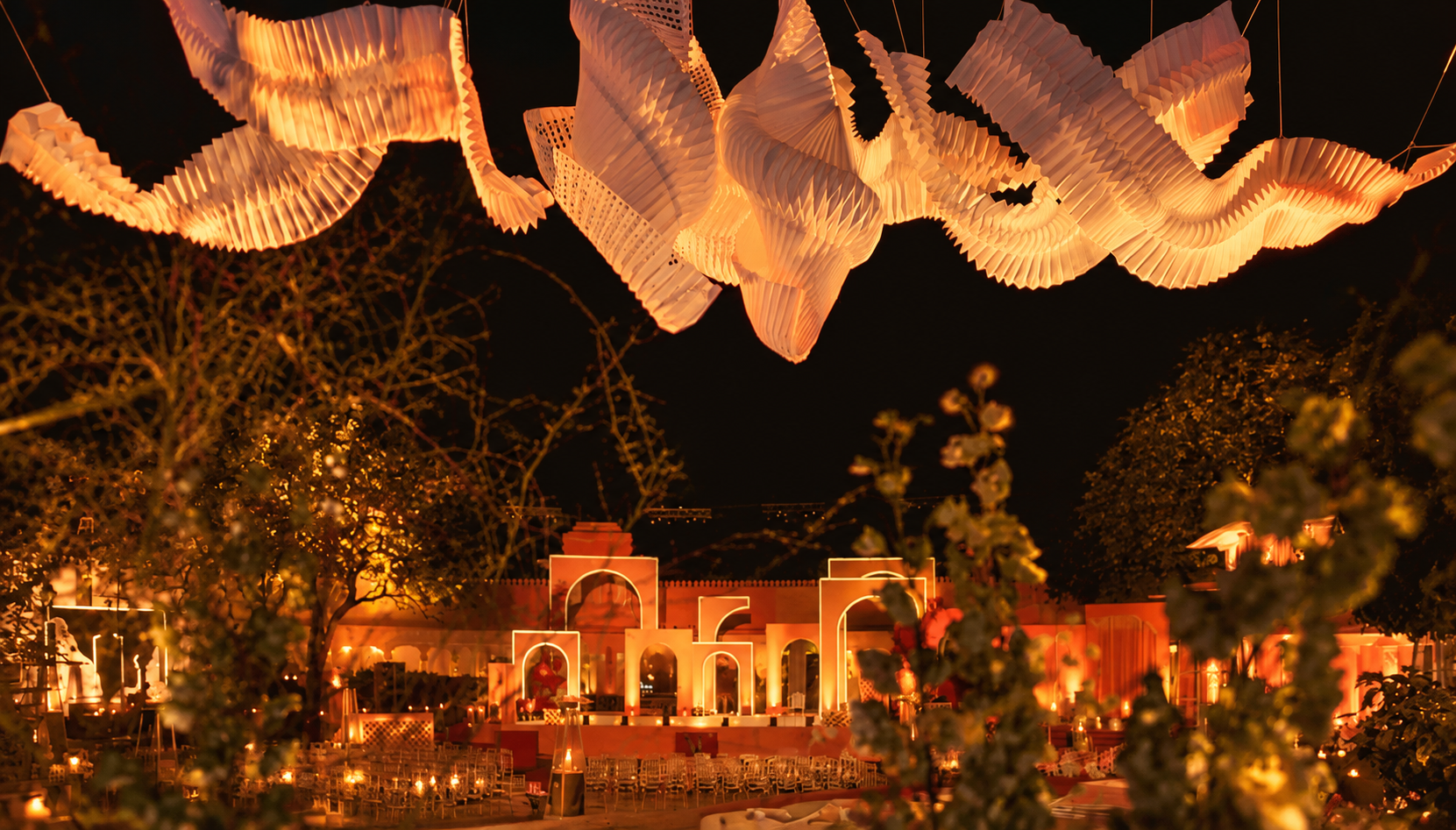
An outdoor image takes the overhead idea in another direction. Pale suspended forms, folded into sweeping shapes, glow against the night. Their repetition creates a visible line above the garden. Beyond them, an architectural facade remains part of the composition. The photograph holds the installation and the setting in the same view, allowing each to establish the scale of the other.
Here, the light helps explain the material. It catches the folds and edges, giving the suspended shapes volume. Their effect would be different if they were seen only as silhouettes. Illumination becomes part of the design of the object, determining what a guest can read from a distance and what becomes apparent on a closer look.
The contrast with the floral canopy is telling. One scheme builds its effect through a profusion of smaller elements. The other gives repeated larger forms room to register. Both make the upper part of the space distinctive. Their different densities suggest how an overhead treatment can influence the mood of a celebration without relying on the same decorative vocabulary.
For a wedding with several occasions, that offers a way to create change. A gathering can feel intimate beneath a closely layered canopy, while another might draw its character from a more open arrangement. The connection between events can come through a palette, a material or the way light is used. Each room can still have an identity of its own.
The profile’s emphasis on spatial planning belongs in this conversation. An installation is experienced in relation to the people below it, the tables around them and the view towards the principal action. The most convincing effect occurs when those relationships feel resolved together. The object overhead becomes part of the room’s proportions, giving the celebration a recognisable shape.
Bring the Eye Back to the Ceremony
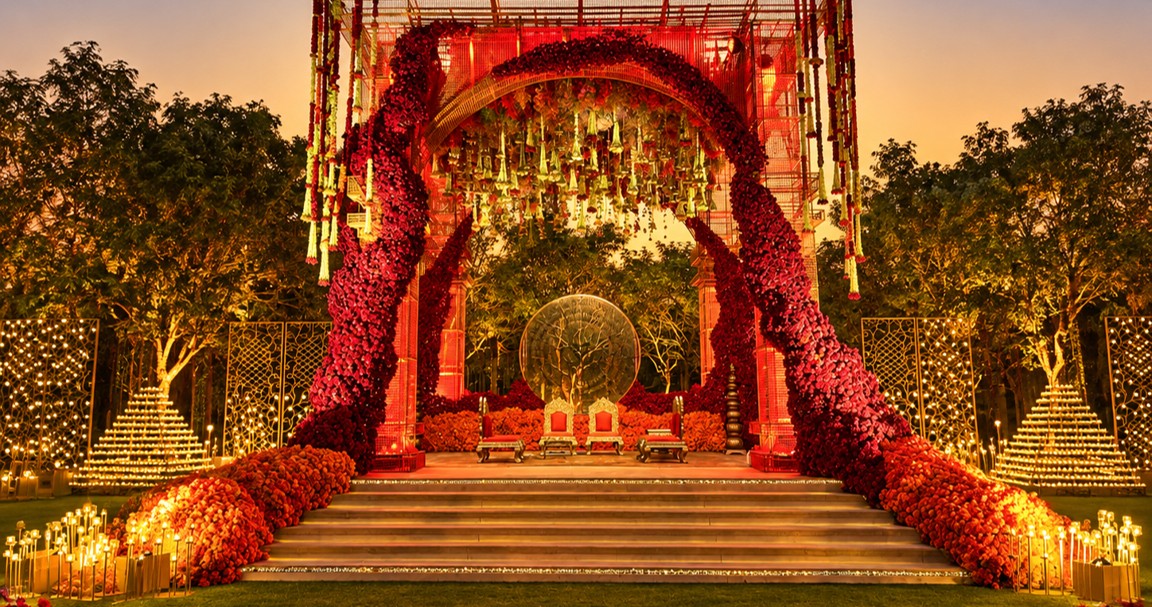
A third photograph returns attention to the ground. A broad staircase leads towards a ceremonial setting framed by an arch of red flowers. Its saturated colour gives the structure a clear outline, while the view through it draws the eye further into the scene. The journey is easy to read: an approach, a threshold and a focal point.
Seen alongside the suspended installations, the arch demonstrates another way to organise scale. Its shape gathers attention around the ceremony. The stairs provide distance, allowing the structure to be encountered before guests reach it. The design has a relationship with movement as well as with the view from the front.
That relationship gives the decorative choices a purpose. A floral arch can be appreciated as an object, but its position also determines what it frames. The setting beyond it needs to remain legible. Likewise, a canopy can bring atmosphere to a room while leaving the couple, a performer or a speaker visible as the focus changes.
Seven Steps’ work places architecture and handcrafted detail within the same brief. In this selection, the larger gesture establishes where attention goes; the closer details reward the time spent looking. The two scales belong together. A celebration benefits from a view that can be understood at once and a setting that continues to reveal itself as guests settle in.
The appeal of looking up, then, extends beyond a striking ceiling photograph. It changes the volume in which the wedding takes place. In these Seven Steps settings, flowers, suspended forms and light give that volume character. The design comes into focus through the people and occasions it surrounds, bringing the grand gesture back to the experience of being there.
Portfolio images supplied by Seven Steps Weddings at 70 EMG.