A Wedding Gifting Brief for the Way Your Guests Actually Live
Think in households, journeys and uses. Different gifts can feel equally considered without turning the guest list into a ranking.
The guest list tells you who is coming. It rarely tells you whether a gift will be shared by a household, carried through two airports or opened by someone who has nowhere to put another large presentation box. Those questions belong in the gifting brief before the packaging is designed.
Start by defining the gesture. Is this a welcome for the weekend, a thank-you for a particular role or an object intended to remain in someone’s home? Each can be generous in a different way. Give the distinction a purpose guests can understand.
Count households as carefully as guests
A couple sharing one room may need one household gift; two friends sharing that room remain two recipients. Decide the rule before anyone orders boxes. Record personal gifts separately from those intended for a family so the distribution team does not have to infer relationships at a desk.
For a shared home gift, consider what the household enjoys. Nicobar’s gifting collection includes teaware and barware formats. That provides a useful starting point for a conversation about use, rather than adding unrelated objects to make every box look equally full. (Nicobar — Gifting sets)
Put weight into the conversation
Nicobar’s published Mahi Gift Set specification describes four mugs and four tea plates, with a listed weight of 2,600 grams. As a format reference, it makes the difference between a household keepsake and a travel gift tangible. The listing was marked sold out when checked; confirm current alternatives and quantities directly with the brand. (Nicobar — Mahi Gift Set specification)
A ceramic set might suit a local household or a gift delivered to its home. A guest travelling onward may appreciate something compact. Ask the gifting partner to show the packed dimensions and actual weight of every proposed version before choosing how it will be distributed.
Give children an intentional version
If children are receiving individual gifts, discuss age suitability and contents with their parents where needed. A quiet activity for a journey has a different purpose from a keepsake. Keep food choices and any relevant dietary information clear, and make sure the desk knows which parcel belongs to which child.
Carry a common visual language across the versions: a material, illustration, colour or personal note. Coherence can come from design even when the contents serve different people.
Keep personal thank-yous personal
A gift for a sibling who helped organise the wedding can be presented privately. It does not need a larger public box that invites comparison with everyone else’s. Write the note around the relationship or contribution, and decide when the couple can give it properly.
For the wider guest gifting, use consistent care in finishing, labelling and the warmth of the message. Different needs should not look like different levels of welcome.
Design the handover too
Agree what is placed in rooms, what is collected and what travels directly to an address. Keep a simple record of delivery and a small reserve for corrections. The best brief follows the gift beyond the presentation photograph to the moment it finds a useful place in someone’s life.
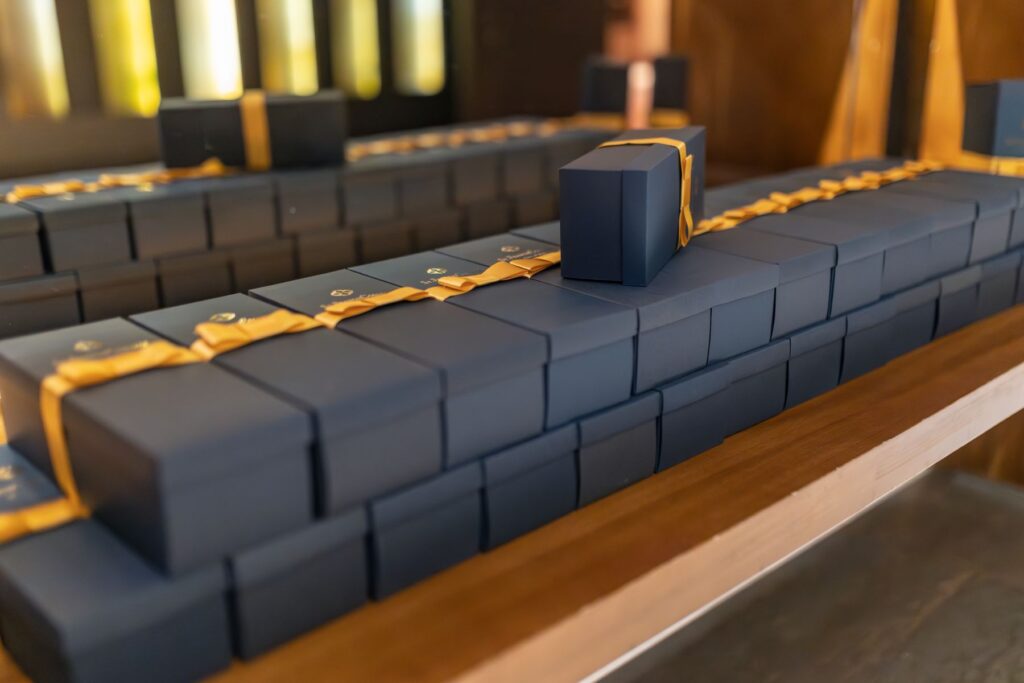
Gift boxes arranged for presentation, with a consistent navy-and-gold finish. Illustrative packaging photograph; not Nicobar products. Photography: Matheus Bertelli. Pexels License. Via Pexels. Original photograph unchanged.
Share this story
More stories like this
Six Invitation Wording Mistakes Beautiful Design Cannot Fix
One Wedding, Five Countries: Rethinking the Guest Gift